Problem
What made this hard
A brand can be cited, described, omitted, or represented inaccurately inside an answer. Rank alone cannot explain that visibility or reveal what to improve.


AI search · Analytics · 2026
Measure how a brand appears inside generated answers.
Problem
A brand can be cited, described, omitted, or represented inaccurately inside an answer. Rank alone cannot explain that visibility or reveal what to improve.
Outcome
A measurement model connecting answer presence, citation share, sentiment, source authority, and topic coverage to inspectable evidence.
The thesis
Case-study proof
Enough context to judge the choice, inspect the work, and separate evidence from ambition.
Why this, not that
I used several evidence-backed measures instead of translating answer visibility into a single rank. Presence, citation share, source authority, topic coverage, and representation explain different parts of how a brand appears.
Why this case is specific
The model depends on captured prompts, generated answers, citations, sources, competitors, and timestamps across answer engines—evidence a traditional search-position dashboard does not contain.
What you can inspect
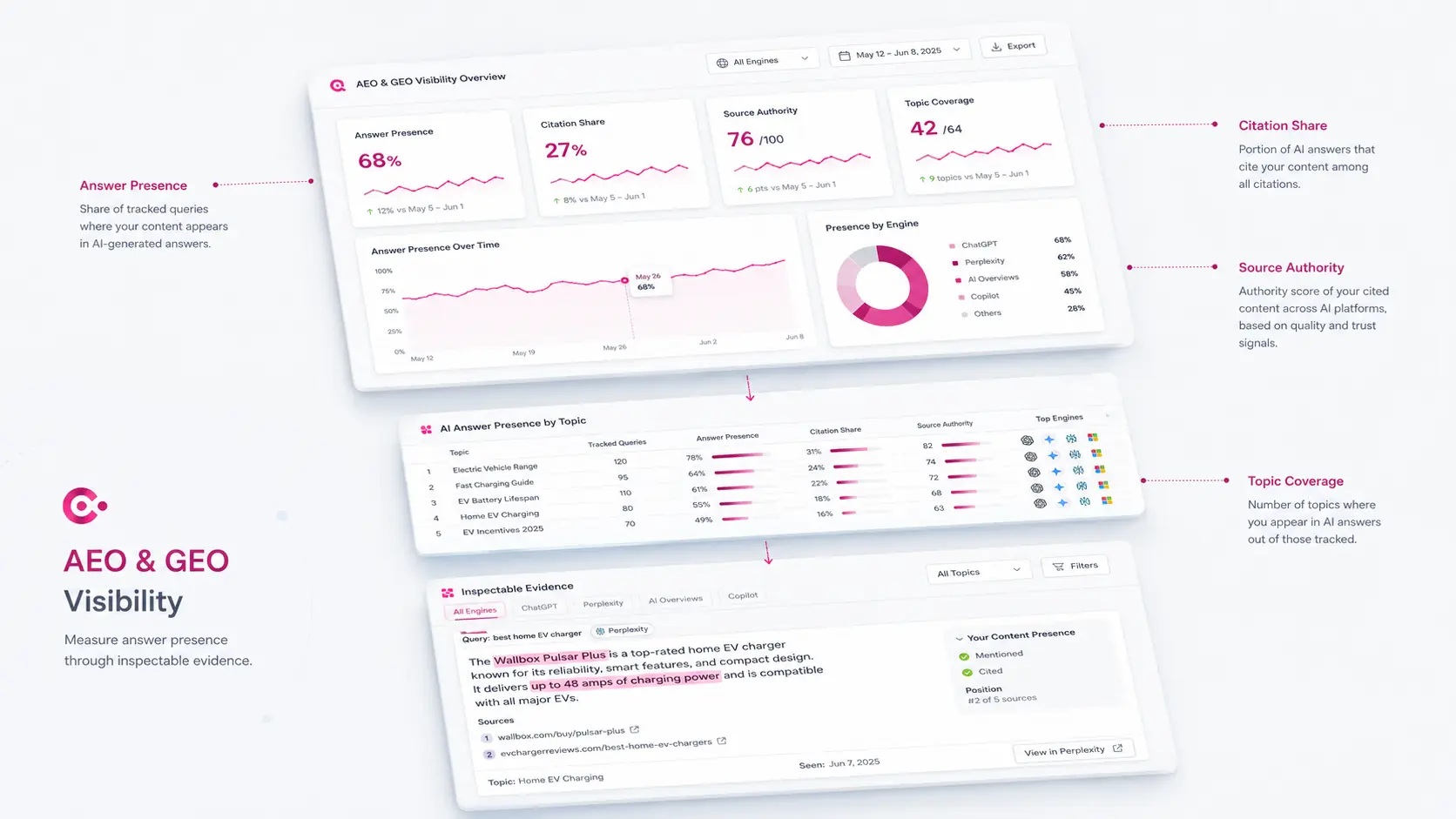
Independent concept · static analytics modelThe dashboard shown is an illustrative static model. It demonstrates hierarchy and drill-down intent, not a live measurement pipeline or validated score.
Decision to outcome
The multi-measure approach produced a trace from overview signal to answer excerpt and citation evidence. Metric definitions and whether the evidence changes optimisation decisions still need expert and user validation.
Interface evidence
I replaced the familiar rank model with evidence about whether the brand appears, how it is framed, which source supports it, and which competitors receive attention.
The overview combines useful indicators without reducing uncertainty to a false single truth.
01 / Reframe
I replaced the familiar rank model with evidence about whether the brand appears, how it is framed, which source supports it, and which competitors receive attention.
02 / Measures
The overview combines useful indicators without reducing uncertainty to a false single truth.
03 / Trust
People can move from an aggregate signal to the captured prompt, answer excerpt, citation, and timestamp. The interface explains why a metric changed.
04 / Boundary
The next step is validating measurement definitions with search strategists and testing whether detailed evidence changes optimisation decisions.
Supporting evidence
People can move from an aggregate signal to the captured prompt, answer excerpt, citation, and timestamp. The interface explains why a metric changed.
The next step is validating measurement definitions with search strategists and testing whether detailed evidence changes optimisation decisions.
Bring me the difficult part.
Complex workflows, AI trust, and enterprise systems.
Discuss a product challenge