Problem
What made this hard
Clients needed faster access, but a public link would weaken accountability. The experience had to balance convenience with permission scope, expiry, revocation, and traceability.


Reporting · Security experience · 2026
Share a report quickly without giving up control.
Problem
Clients needed faster access, but a public link would weaken accountability. The experience had to balance convenience with permission scope, expiry, revocation, and traceability.
Outcome
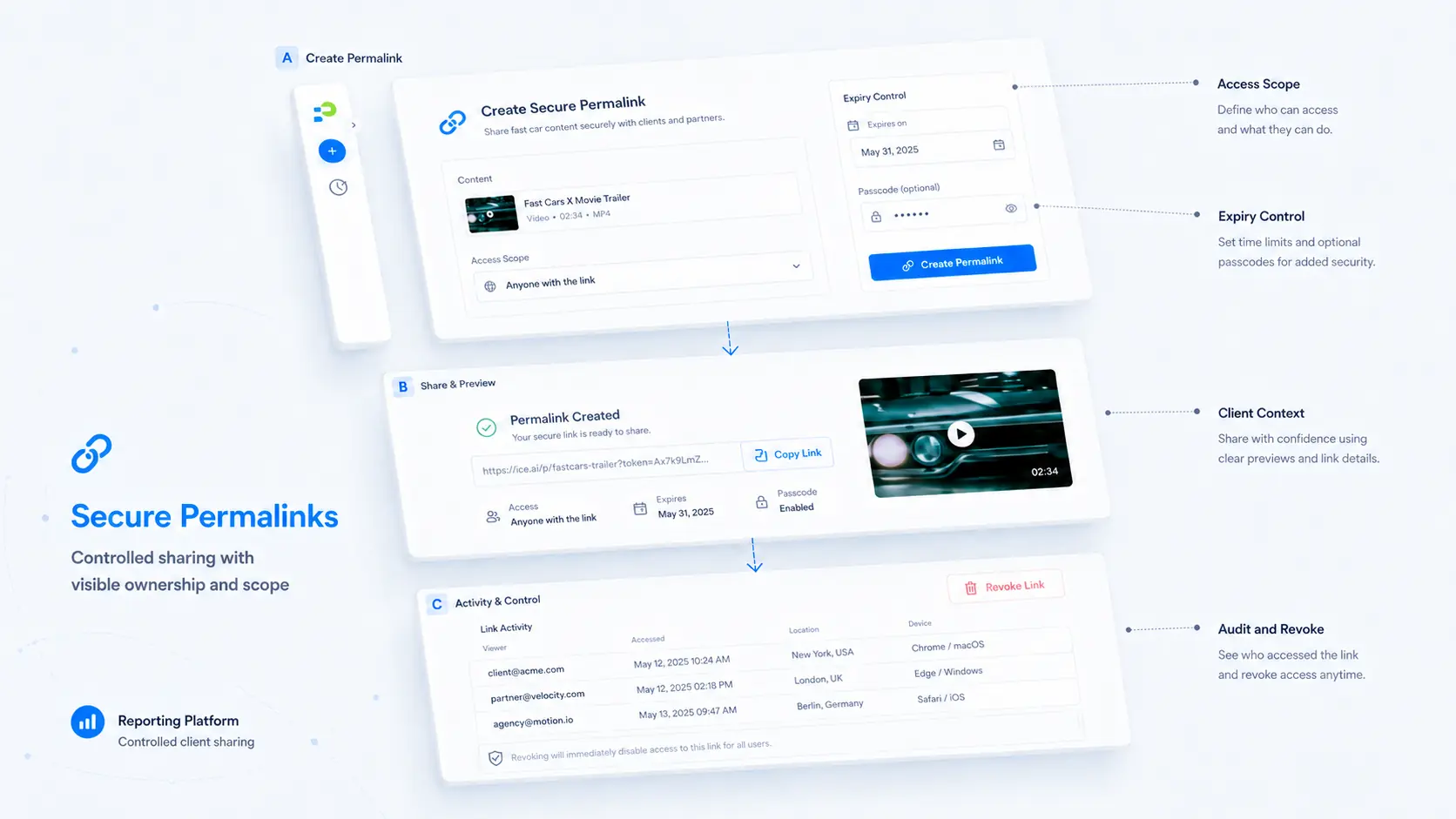
A governed sharing model where administrators set boundaries before creating a link, then review or revoke every active share from one place.
The thesis
Case-study proof
Enough context to judge the choice, inspect the work, and separate evidence from ambition.
Why this, not that
I treated each share link as a governed object instead of an anonymous public URL. The extra setup step was intentional: ownership, view-only scope, expiry, recent access, and revocation had to remain inspectable.
Why this case is specific
The concept addresses agency administrators sharing TapClicks-style client dashboards, where faster access still has to coexist with permission scope and an audit trail.
What you can inspect
Independent concept · static interface modelThe page shows a create-link state and an active-share ledger. These are static concept screens, not a functioning permission system.
Decision to outcome
The model connects the decision to add governance with an auditable create-and-revoke flow. Security review, administrator comprehension, and telemetry remain required before any release claim.
Interface evidence
Opening a report can be easy while the decision about who can see it remains deliberate.
Each share has an owner, scope, expiry, and status rather than behaving like an anonymous address.
01 / Tension
Opening a report can be easy while the decision about who can see it remains deliberate.
02 / Model
Each share has an owner, scope, expiry, and status rather than behaving like an anonymous address.
03 / Experience
Recipients see the reporting surface they already know. Administrative controls remain outside the client view, reducing confusion and accidental exposure.
04 / Next
The model still needs security review, administrator testing, and telemetry for creation, access, expiry, and revocation before release.
Supporting evidence
Recipients see the reporting surface they already know. Administrative controls remain outside the client view, reducing confusion and accidental exposure.
The model still needs security review, administrator testing, and telemetry for creation, access, expiry, and revocation before release.
Bring me the difficult part.
Complex workflows, AI trust, and enterprise systems.
Discuss a product challenge