Problem
What made this hard
The previous flow exposed technical dependencies too early and made recovery difficult. Teams had to interpret infrastructure language before they could make a safe setup decision.


Enterprise storage · Systems UX · 2023
Turn infrastructure setup into a guided sequence of decisions.
Problem
The previous flow exposed technical dependencies too early and made recovery difficult. Teams had to interpret infrastructure language before they could make a safe setup decision.
Outcome
A guided installation model that makes system checks, consequential choices, and recovery paths understandable.
The thesis
Case-study proof
Enough context to judge the choice, inspect the work, and separate evidence from ambition.
Why this, not that
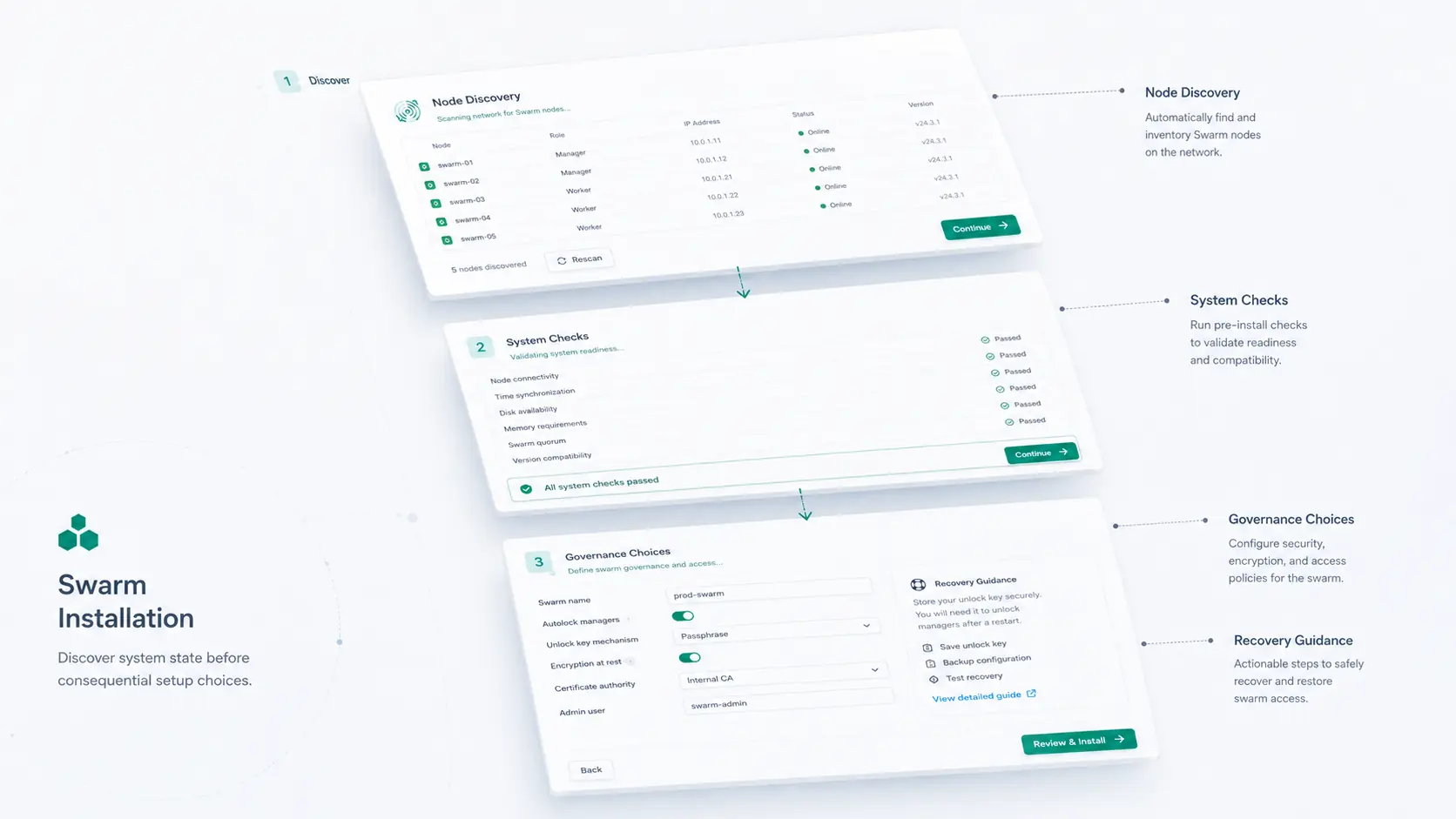
I moved automatic discovery and system checks ahead of governance choices instead of exposing every infrastructure dependency in one technical wizard. Automation handled what the system could know; consequential decisions stayed explicit.
Why this case is specific
The flow is specific to object-storage installation: node discovery, capacity and network checks, then retention, replication, immutability, quota, and recovery guidance.
What you can inspect
Shipped workflow · illustrative reconstructionThe page reconstructs the shipped sequence and its decision points in a static interface model. It communicates the workflow, but it is not a live installer or a production screenshot gallery.
Decision to outcome
The shipped sequence gave teams a visible next step after each check and kept high-consequence configuration readable. No completion-rate or support-ticket metric is asserted.
Interface evidence
01 / Understand
I organised the flow around four questions: what was found, what needs a decision, what could block progress, and what is safe to do next.
02 / Sequence
Discovery, capacity, and network checks run before users reach governance choices.
03 / Safety
Retention, replication, immutability, and quota decisions include direct explanations and confirmation. People never have to infer whether a consequential change succeeded.
04 / Evidence
The redesign simplified the path without hiding the infrastructure. The case demonstrates the resulting sequence, decision points, system feedback, and recovery guidance without relying on unverified estimates.
Supporting evidence
I organised the flow around four questions: what was found, what needs a decision, what could block progress, and what is safe to do next.
Discovery, capacity, and network checks run before users reach governance choices.
Bring me the difficult part.
Complex workflows, AI trust, and enterprise systems.
Discuss a product challenge